
Exporter of Advices
The consulting company SavvY has been contributing to the financial success of businesses in both Georgian and international markets for ten years. Its portfolio includes more than 100 projects and long-term collaborations with global organizations. In an interview with Forbes Georgia, Mariam Koyava, the founder and managing partner of SavvY, discusses the company's development path, international expansion, and future plans.
Mariam, you were very young when SavvY was founded. Did you already have the knowledge and experience in this field that helped you turn it into a successful business?
I have a degree in finance. Before founding my own company, I began my career at the age of 21 as an auditor at an international auditing firm — a stage that proved to be a defining milestone in my professional journey. The experience and practical skills I gained there helped me in my future development very much. Afterwards, I moved to the banking sector. During this period, I was deeply engaged in delivering professional services, whether in auditing, consulting, or banking. Eventually, I realized that consulting was the field of my interest and decided to establish my own company. SavvY entered the Georgian market ten years ago, in November 2015.
What were the first steps like? What challenges did you face?
When we started this business, one of the main obstacles was a lack of experience. Initially, potential clients were skeptical, since SavvY was a new company and had no implemented projects to gain trust. Convincing them that we could deliver on our promises without a concrete example was very difficult. The second major obstacle stemmed from the prevailing perception of the consulting sector at that time and its damaged reputation. Unlike a product, a service is much harder to sell, as people often find it difficult to imagine exactly what they will receive. Therefore, clearly demonstrating the value of our services was a major challenge. The third major challenge was defining our target segment and identifying who our clients should be. Many well-intentioned peers advised me to start with smaller firms, since we were new to the market and I was quite young to gain the trust of large corporations. However, my perspective on consulting was different: when a company faces a particular problem, finding a solution doesn’t really depend on its size. A consultant devotes the same time and commitment, whether it’s a small enterprise or a large corporation. At the same time, smaller companies typically have limited financial resources. I believed that if we positioned ourselves solely as a firm serving small businesses, we would remain confined to that segment. Therefore, from the outset, establishing partnerships with large, reputable organizations was both our goal and our greatest challenge. These collaborations would allow us to build a strong market presence and position SavvY as a trusted provider of high-quality consulting services.
How did you manage to earn trust? How long did it take to achieve that?
Our first major client was PSP, a company of unimaginable scale for a startup consulting firm. They commissioned us to transform the entire holding’s financial reporting in accordance with international standards. On one hand, it was an enormous responsibility; on the other, successfully completing this project had the potential to significantly strengthen trust in SavvY. It is also interesting, how we won the project. Surprisingly, it happened through training. When we realized there were many barriers to establishing ourselves in the market, we decided to demonstrate our team’s expertise in a different way. We organized professional training sessions, which proved to be extremely valuable. To date, I have personally trained nearly 21,000 professionals in the field. A representative of PSP attended one of these training sessions and told me that he had come to learn more about our company, our expertise, and what we could offer the market. He was impressed by SavvY’s professionalism and team expertise and mentioned that PSP’s financial director wanted to schedule a meeting with us. I can confidently say that this moment marked a turning point, presenting a real opportunity for one of Georgia’s largest companies to become our client. The history of PSP and SavvY's collaboration was a success achieved through hard work and dedication. During this project, we did not engage in any marketing for an entire year, not only because no one knew what SavvY was, but also because our priority was to focus on delivering quality work.
What was the outcome of this partnership for SavvY itself?
After completing the project successfully, SavvY began attracting interest from other major companies and organizations. This interest grew so quickly that, by 2018, we had already won a major USAID tender: a nationwide project to raise awareness of international financial reporting standards across Georgia. I highlight this project because, at the time, USAID would not have entrusted such an important initiative to a startup without confidence in us. Over time, the company’s visibility and credibility continued to grow, likely because we consistently fulfilled our promises to partners — and often exceeded their expectations.
In a market with increasing competition, what makes SavvY’s services stand out?
First of all, I’d like to highlight that today’s SavvY is very different from the company that first entered the market. We started with just two areas of focus, but now we offer a wide range of services. Before discussing specific directions, I’d like to share SavvY’s vision of the goals our services are designed to address. We have just two key objectives. The first is financial optimization, which involves developing stronger financial strategies, raising capital efficiently, facilitating quality investments, and establishing an appropriate financial structure. In simple terms, we excel at understanding where, from whom, why, for what, and how funds can be raised. The second objective is growth in income. Every service we provide should either strengthen an organization’s financial structure or increase its revenue. This principle guides the expansion of SavvY’s services. When a partner evaluates the impact of collaborating with us, the results should be clear and measurable. Consequently, our services include financial management, support in strategic financial decision-making for companies, business planning, technical and economic studies, and assistance in international trade, which involves helping clients find strategic partners for export. We also provide business and asset valuation, among other services. These are the services that consistently help investors, businesspeople, and top management make strategic decisions. I should also note that our strategy is not to offer as many services as possible. We prefer to be a boutique consulting firm that truly masters what it does and does it at the highest level.
The company has been actively present in the Uzbek market. Recently, several projects were announced. Why this country? In general, what does the map of SavvY’s service exports look like?
Working in different markets has always been interesting for us. SavvY is one of the best examples of how services can be exported from Georgia. As you noted, we have already established a strong presence in Uzbekistan, but we are also active in countries such as the United Kingdom, Sri Lanka, Israel, the United States, and others. Geographic diversification provides both the company and its team with significant opportunities for growth and exposure to new business practices. Returning to Uzbekistan, we never enter a market without holding a substantial portfolio there. Our exploration of this market began three years ago. Central Asia is particularly interesting due to its large economy, geographic and cultural proximity to Georgia, and rapid economic growth. When an economy grows quickly, consultants play a significant role in almost every sector. In Uzbekistan, we have already completed numerous projects in both the private and public sectors. Notably, SavvY also assists Saudi Arabian companies entering the Uzbek market, leveraging experience gained from projects in Saudi Arabia. This market is particularly promising and interesting for us. We are assisting the government of Uzbekistan in developing its strategy for attracting foreign direct investment — a project of great scale and responsibility. In addition, we collaborate with international organizations on initiatives aimed at enhancing the business skills of women entrepreneurs. I would also like to emphasize that SavvY is engaged in projects that are not only professionally significant but also emotionally meaningful. We hope to further expand our portfolio in this market. From the very beginning, SavvY’s strategy has been to enter both developed and emerging markets. At this stage, our priority is to establish a strong presence across the Middle East, the Caucasus, and Asia.
Which sectors show the highest demand for consulting services? How do the markets differ in this regard?
First of all, I’d like to emphasize that we’re not limited to any specific sector and can support any activities backed by international financial institutions. In terms of geography, demand in the Caucasus and Central Asia is particularly strong in the real estate sector, in its broadest sense. Tourism, logistics, and manufacturing — especially light industry — are also very active. Demand from the agricultural sector is steadily increasing, and the technology sector continues to show great potential. These are the key industries where SavvY’s clients are most active today.
As you mentioned, SavvY is a boutique consulting firm. When handling large projects, does the team have sufficient resources?
Yes, we cannot employ thousands of people, but it should be noted that we do not offer operational services such as outsourced accounting. In that case, we would be a completely different type of organization. Our boutique approach is reflected in how we select clients and, accordingly, projects. For us, the focus is not on the number of projects, but on their complexity and the impact our involvement can have. Moreover, given the complexity of our projects, we are always open to strategic partnerships. If collaborating with a partner can achieve greater results, we never hesitate. The most important thing is reaching the goals we have set. For example, over the past two years, we have worked closely with the international consulting firm Moore Global, providing the market with Floating CFO services. Why this collaboration? Because Moore has an excellent outsourced accounting team, while we have strong financial analysts. By combining the strengths of these two teams, we deliver faster and better results for our clients. We have had similar collaborations in the past with banks and international donor organizations. We have successfully partnered with Bank of Georgia and TBC Bank, and have been repeat contractors for USAID. In short, we have worked on a wide range of projects with nearly every major donor and international financial institution in the region.
For projects of such scale, the team plays a critical role. Who is behind SavvY?
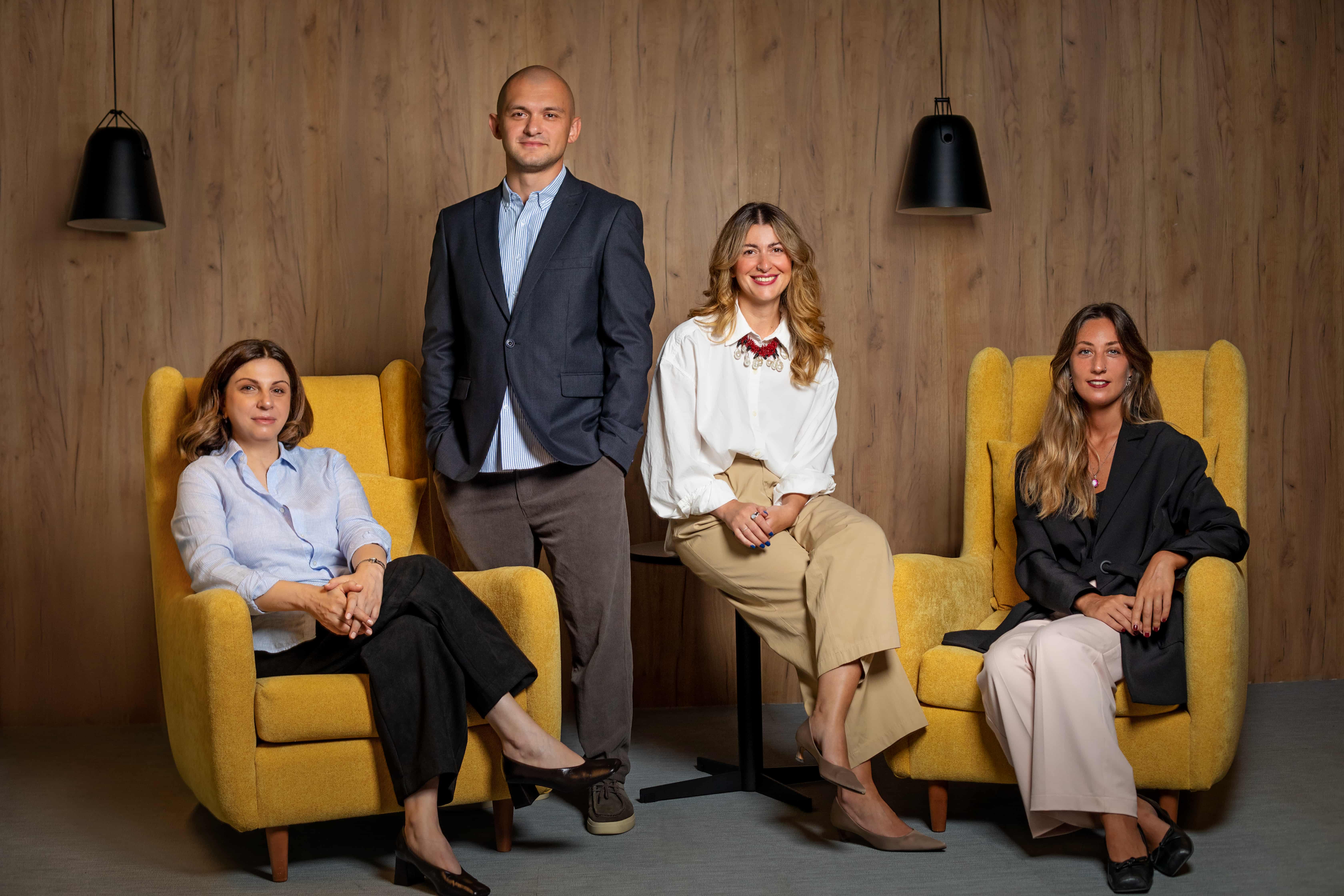
In our business, the team must be full of champions. Our services are created by the minds of people; they are not products that can be made once and sold repeatedly. For this reason, the team is extremely important to SavvY. The company’s department heads and partners fully share SavvY’s vision; they are hardworking, exceptional, and courageous. We are committed to out-of-the-box thinking and make equally exceptional decisions. A few years ago, when we began considering geographical expansion, it seemed impossible to many. Yet, thanks to our strong and outstanding team, we were able to achieve it. Every successful step the company takes is the result of the entire team’s effort.
Finally, what are SavvY’s plans for the future?
We plan to put even greater effort into exporting our services, aiming to establish a full presence in multiple markets. At the same time, implementing large-scale projects is very important to us. For example, the consulting centers project in Georgia, which we began working on in 2019, is now being successfully implemented by the agency “Produce in Georgia”. We hope to undertake similar large-scale projects in other countries as well.